NEW YORK — A routine credit decision at one of America’s largest artificial-intelligence companies rippled through the debt of power projects in six states on Monday, as investors reassessed how much infrastructure finance ultimately depended on a single corporate customer.
Alden Ridge Ratings lowered Quarrylight Compute’s senior rating to AA from AA+, citing rising debt, heavy capital spending and decades of fixed infrastructure commitments. The agency assigned a stable outlook and said the company remained strongly cash-generative, with substantial liquidity and no near-term difficulty meeting its obligations.
The one-notch move nevertheless pushed down bonds associated with advanced nuclear, enhanced geothermal, transmission and storage projects for which Quarrylight had signed long-term minimum-payment contracts. About $19.6 billion of project debt traded at wider spreads during the session, according to composite bond-market data reviewed by The Verran.
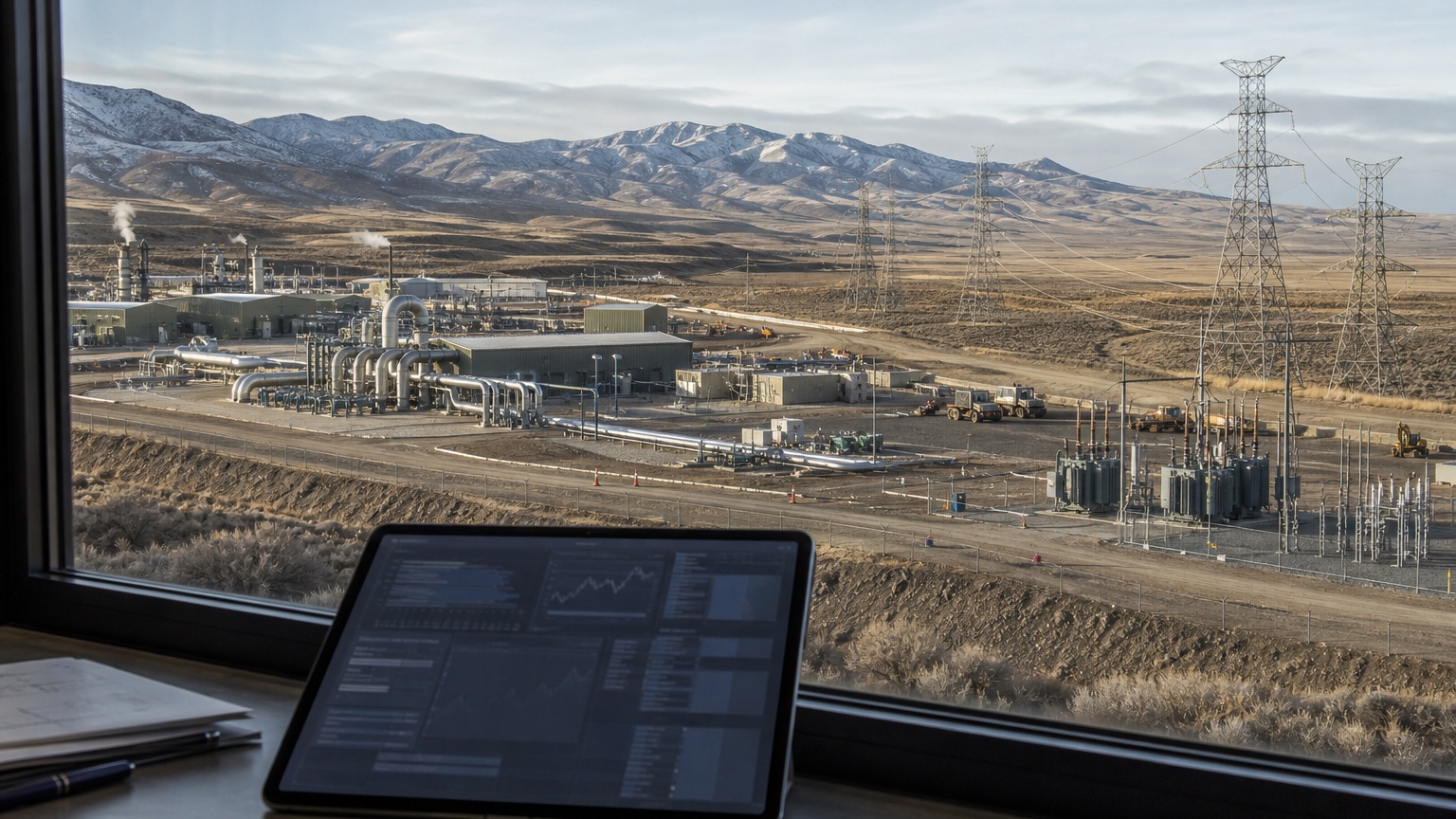
Bonds financing Nevada’s Desert Gate geothermal complex fell 2.6 cents on the dollar, while senior debt for the Buckeye Advanced Energy Center in Ohio declined 3.8 cents. Debt tied to an Arizona transmission expansion and a Texas long-duration storage project widened by between 12 and 19 basis points relative to comparable securities.
Alden Ridge placed the Buckeye project on review for a possible downgrade because Quarrylight accounts for nearly three-quarters of its contracted capacity payments. It left the ratings of the other projects unchanged.
No project missed a payment, no plant shut down and no existing fixed-rate bond began paying a higher coupon. Prices declined in secondary trading, which raised the yield demanded by buyers. The practical effect will appear if exposed projects refinance, extend construction debt or return to the market for new borrowing.
Quarrylight shares closed 2.9% lower. The company said the rating action would not alter its power purchases, infrastructure program or current capital plan.
“Quarrylight’s operating performance remains exceptionally strong, and every contracted payment was made as scheduled,” Chief Financial Officer Leena Park said in a statement. “The downgrade reflects a more conservative treatment of long-duration commitments, not a change in our capacity or intention to honor them.”
The affected projects were not financed on the assumption that Quarrylight would merely want electricity in the future. Their lenders relied on take-or-pay contracts, availability agreements and parent-backed capacity commitments that require substantial minimum payments whether or not the company uses every contracted unit of power.
The Buckeye project illustrates the structure. Its operator raised $8.4 billion to build a group of advanced reactors after Quarrylight agreed to pay for a large block of firm capacity for 30 years. Quarrylight does not own or operate the reactors. But its commitment gave lenders confidence that the project would have a predictable stream of revenue while construction costs were repaid.
In ordinary terms, the developer wanted to build a power plant and lenders asked who would pay for its output over the next generation. Quarrylight’s signature supplied part of the answer.
Quarrylight disclosed $286 billion of undiscounted future minimum commitments under energy, capacity, transmission, water and infrastructure agreements at the end of 2043. The figure does not mean the company owes $286 billion today. It represents payments scheduled over periods that extend as long as 32 years, many of which support assets that other companies own and operate.
Alden Ridge said it had increased the weight assigned to those obligations in its fixed-commitment-adjusted leverage measure. Conventional debt also rose after two large acquisitions and three years of record capital spending, while free cash flow did not grow as quickly as operating earnings.
“None of those developments is extraordinary on its own,” said Marta Solis, the Alden Ridge analyst who led the review. “Our conclusion is that the combined financial profile is more consistent with AA. That remains a very strong rating.”
The market reaction extended beyond Quarrylight because many lenders had treated its promise to pay as a central form of credit support. The company became an anchor customer for power and industrial projects as its model infrastructure, enterprise systems, consumer agents and data-center network expanded through the 2030s.
The episode exposed what credit analysts called a hidden concentration: physical diversification across regions and technologies had not necessarily produced counterparty diversification.
An investor could hold a Nevada geothermal bond, an Ohio reactor financing, an Arizona transmission issue and a Texas storage security, each with a different operator and regulatory structure. If the same Compute Major supports the contracted revenue beneath all four, part of the credit risk is shared.
“Investors thought they owned four different infrastructure risks,” said Elena Ward, an infrastructure-credit analyst at a New York asset manager. “In one important respect, they owned the same credit four times.”
The realization has pushed the phrase “compute concentration risk” into Monday’s investor calls. The term refers not to market share in AI services, but to the dependence of supposedly separate physical projects on the balance sheets and long-term payment commitments of the same small group of Compute Majors.
Frederick Halvern, chairman of Halvern Holdings and a longtime investor in several major compute companies, described the underlying question more simply in a 2042 interview with The Verran.
“People talk about who owns the power plant,” Halvern said. “I usually ask who signed up to pay for it.”
Halvern was referring to the purchase and availability contracts that had become central to financing new nuclear, geothermal, transmission and storage projects. His observation was not a prediction of Monday’s downgrade; it described the cash-flow logic that made its effects travel beyond Quarrylight’s own bonds.
The projects also have protections that limit the damage. Their financing documents include reserve accounts, termination payments, collateral, replacement-customer rights and, in some cases, commitments from utilities or other corporate buyers. Electricity from many of the assets can be sold elsewhere, although not always at the price or on the timetable assumed in the original financing.
Projects with multiple anchor customers or utility support moved little. Traditional regulated utility debt was broadly unchanged, as were older plants and federally financed infrastructure. Monday’s repricing was concentrated in newer projects whose financing depended heavily on one corporate demand guarantee.
“This is not 2008,” said Daniel Okafor, who oversees infrastructure credit for a large pension manager. “The assets are operating, the electricity has value and most of the bonds remain investment grade. What was underestimated was the number of roads that led back to the same payer.”
Lenders said new financings may respond by requiring more than one major anchor customer, larger debt-service reserves or clearer disclosure of the ultimate concentration behind contracted revenue. Some structures could combine Compute Major commitments with regulated utility demand or cap the share of revenue tied to a single company.
Those changes would make some projects more resilient. They could also make large new energy developments harder or more expensive to finance, particularly where few customers can make commitments at the scale needed before construction begins.
For years, the physical buildout of the AI economy appeared geographically and technologically diverse. Monday’s trading offered a reminder that the promises financing it were sometimes less diversified than the reactors, storage plants and transmission lines themselves.
Reader forecast
Do you buy this future?
When do you think the credit ratings of major AI and compute companies materially affect financing costs for U.S. power and infrastructure projects?
Relative to this report's 2044 date. One prediction per browser. Predictions cannot be changed after submission.