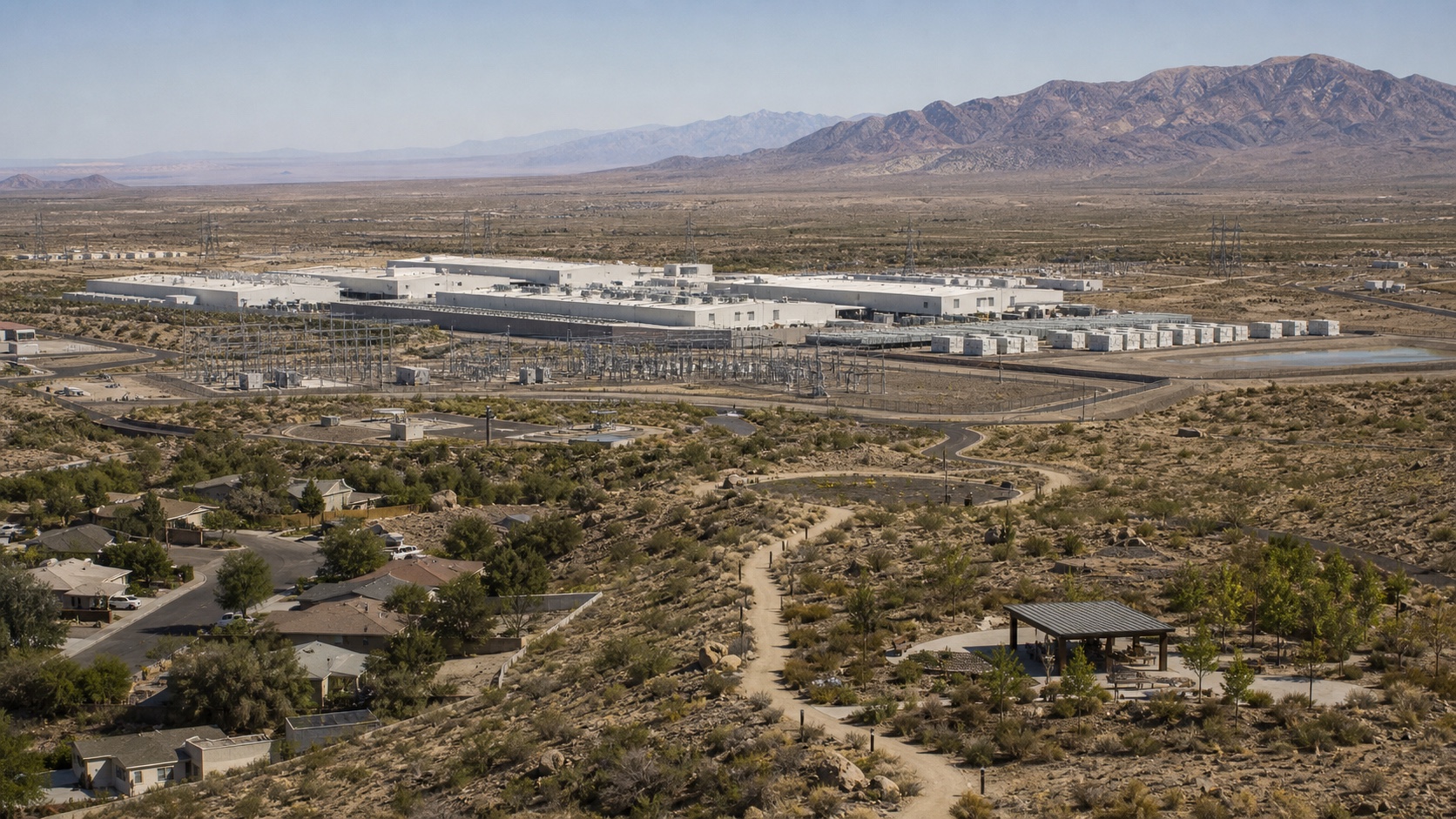
JUNIPER COUNTY, Nev. — The U.S. Energy Department invoked a rarely used federal siting review on Friday after a Nevada county rejected a proposed Strategic Compute campus, opening a legal fight over whether Washington can approve nationally important AI infrastructure despite local opposition.
The notice allows the department to reconsider Juniper County's 4-1 denial of the Pinyon Creek Strategic Compute Campus, which had already received a federal designation reserved for projects considered important to national research, industrial and security capacity. It does not authorize construction by itself, but could lead to a federal permit overriding the county vote.
County officials and Nevada's attorney general asked a federal appeals court to block the review hours after it was announced. They said the government was treating compliance with national standards as a substitute for local consent.
The dispute is an unusually direct test of the 2038 Strategic Compute Infrastructure Act, which gave the federal government narrow authority to approve designated projects when local decisions threatened a documented national capacity need. The law requires an independent assessment of alternatives, local burdens and proposed mitigation, and permits judicial review.
Federal officials said Pinyon Creek was a strong candidate for review because the region offers a scarce combination of firm electricity, transmission access, available substations and power-ready land. The campus would be capable of drawing more than two gigawatts at full buildout, according to planning documents.
The developer proposed closed-loop cooling, a reclaimed-water contribution larger than the campus's projected consumption and contracts for new generation, storage and grid upgrades. Its agreement would also finance roads, emergency services, a decommissioning bond and a 30-year local revenue package.
Those commitments meant the debate was not chiefly about water use, noise or uncovered public costs, issues that derailed many Compute proposals in the 2020s and early 2030s.
Juniper County said the project met the standards expected of a modern campus. It rejected the premise that meeting them created an entitlement to build.
“We have not found that this is a dirty project or a dishonest offer,” County Commission Chair Elise Maren said before the vote. “We have found that this county has carried a nationally significant share of this infrastructure, and that its residents are allowed to decide when that share is enough.”
The county already hosts three major Compute campuses. Each campus contains several hyperscale-class facilities — the individual data halls and supporting plants often described separately in national inventories — connected through shared power, network, water and security infrastructure.
Existing operators are among the county's largest taxpayers and have funded vocational programs, substations and road improvements. Local unemployment is below the state average. Project supporters said another campus would extend those gains and strengthen an industry on which households, businesses and public services now depend.
Opponents did not dispute those benefits. Their most persistent complaint concerned what residents call “two-tier reliability” during extreme summer heat. Households are sometimes asked to conserve power while existing campuses continue operating under firm-service contracts backed by generation and grid investments they helped finance.
Utility officials say the campuses do not necessarily cause those conservation requests and that their contracts pay for incremental capacity. Residents say the contrast still matters: one class of customer can purchase continuity while another experiences reliability as a civic obligation.
“I'm not against AI. I use it every day,” said Nessa Calder, a public-school librarian who lives near the proposed transmission corridor. “There are already three campuses around us. How many counts as our share?”
The transmission plan would also cross land reserved for Juniper Commons, a county-backed public retreat with walking paths, gardens and device-free rooms seeking certification through the Clearland Network. Clearland groups, which support spaces where people can withdraw from default personal AI systems, joined ranchers, conservation organizations and residents concerned about growth.
The coalition did not argue that the campus itself violated Clearland principles. It said the new transmission corridor and security perimeter would make the planned retreat impractical at that site. The developer offered to fund relocation, an answer supporters considered reasonable and opponents saw as proof that local priorities remained movable while the national project did not.
The United States operates roughly 1,500 hyperscale-class facilities distributed across more than 650 major Compute campuses, according to the most recent federal inventory. Capacity continues to expand even as cheap and abundant electricity has reduced the importance of fuel cost in siting decisions.
The harder constraint is delivery: firm power at the required hour, high-capacity transmission, interconnection approval, substations, transformers and large parcels that can be made ready on schedule. Federal officials say allowing a small number of counties to reject otherwise compliant projects could turn those bottlenecks into a national vulnerability.
Juniper County's filing said that argument could make the federal exception effectively permanent. Any place with the infrastructure to host a major campus, it said, could be deemed too important to refuse one.
The Energy Department said it would accept public submissions for 45 days and had not decided whether to issue a federal permit. It also said the act requires it to consider other sites and whether additional concessions could reduce the local burden.
Calder said compensation was part of the decision but not the whole of it. “The jobs are real and the money is real,” she said. “But the shareholders are elsewhere, the decisions are elsewhere, and the buildings are here.”
Reader forecast
Do you buy this future?
When do you think the U.S. federal government can override some local rejections of nationally strategic AI and Compute infrastructure?
Relative to this report's 2044 date. One prediction per browser. Predictions cannot be changed after submission.