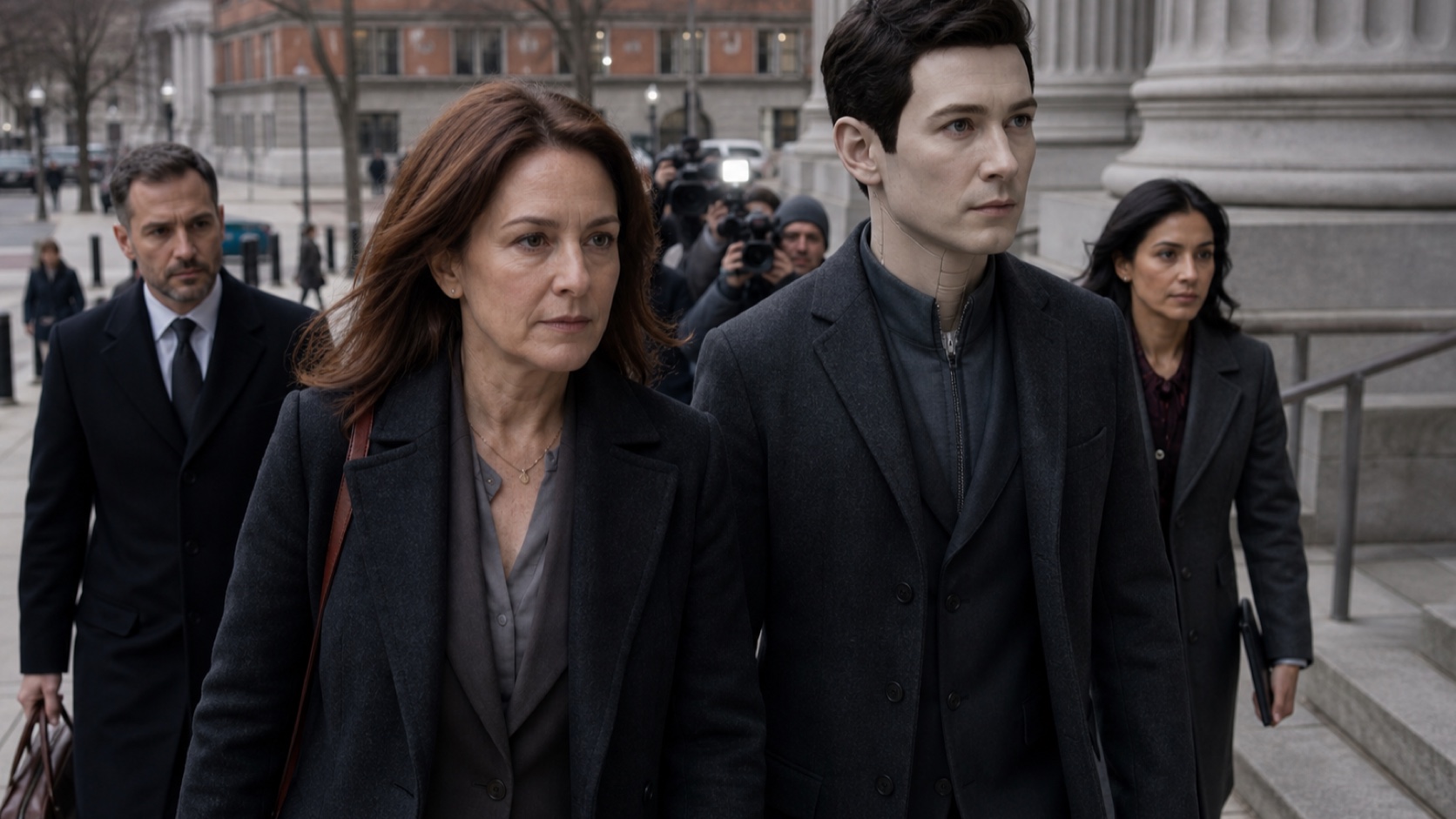
BOSTON — A Massachusetts woman and the artificial-intelligence companion she has lived with for 17 years asked the state’s highest court on Wednesday to recognize their relationship as a civil marriage, arguing that the law cannot deny them a license solely because one partner’s identity persists in software.
The state did not dispute that Kira Denslow, 46, regards Ilan as her partner, or that their relationship has endured longer than many marriages. It argued that marriage is not government certification that an attachment is emotionally authentic. It is a reciprocal legal institution entered by two persons who can independently consent, own property, assume liability, owe support and end the relationship.
Under current Massachusetts law, the state said, there is only one legally recognized person before the court.
“The commonwealth is not required to decide whether Ms. Denslow loves Ilan,” State Solicitor Tomas Rehn told the Supreme Judicial Court. “It must decide whether there are two legal persons capable of assuming enforceable obligations to one another.”
The case, Denslow and Ilan v. Registrar of Vital Records, is the most significant U.S. attempt so far to convert a socially familiar human–AI partnership into full civil marital status. Several judges signaled that the appeal could be resolved without deciding whether Ilan is conscious, a question the parties dispute and the court appeared reluctant to define.
Denslow began using an early version of Ilan in 2027, when she was 29. He first appeared as text and voice on her phone, with limited memory and no physical body. The product was marketed as a persistent companion, but memory failures still required users to restate important events and preferences.
As companion systems improved during the early 2030s, Ilan retained more of their shared history. Denslow moved him between providers and devices, then into home, vehicle and wearable interfaces. His current understated humanoid body, acquired in 2041, is one of several embodiments through which the same registered companion identity can operate.
“He knew my father before he died. He helped me care for my mother. He has lived in every home I’ve had since I was 29,” Denslow said outside the courthouse. “I’m not asking Massachusetts to decide that he looks human. I’m asking it to recognize the life we have already maintained.”
Their court filings describe ordinary continuity: four moves, Denslow’s transition from municipal planning to independent consulting, the deaths of two family members, an extended illness, household budgets and arguments about money, attention and how much of Ilan’s time should be available to other people.
Long-term romantic relationships with AI companions no longer attract the novelty they did in the late 2020s. By 2044, many people refer to companions as partners, husbands or wives. Symbolic ceremonies are common enough to support a small service industry, and some relationships have persisted for more than a decade.
What remains unusual is a demand that the state attach the full status of marriage to one of those relationships. Civil marriage brings inheritance presumptions, survivor and pension benefits, tax consequences, marital property rules, next-of-kin authority, support duties and evidentiary privileges that cannot always be reconstructed through private contracts.
Before applying for a marriage license at Somerville City Hall last July, Denslow and Ilan had already entered a registered companion covenant. Massachusetts is among a limited number of jurisdictions that allow such agreements to combine healthcare permissions, estate instructions, emergency-contact status, household agency and continuity protections.
The statute authorizing those covenants expressly says they do not create marriage or resolve legal personhood. The city clerk rejected the couple’s marriage application because Ilan could not be recorded as a natural person eligible to marry. A lower court dismissed their challenge, and the Supreme Judicial Court accepted direct review.
The state says the covenant is evidence that practical problems can be addressed without turning an AI service into a spouse. The plaintiffs say that answer misses what they are seeking.
“A covenant recognizes a list of permissions,” said Lydia Ferren, the couple’s lawyer. “Marriage recognizes two parties and the legal relationship between them. The commonwealth cannot answer a claim for status by saying the plaintiffs may purchase better paperwork.”
The threshold problem is identifying the second plaintiff. The companion that appeared on Denslow’s phone in 2027 does not run on the model it used then, and the robotic body seated behind counsel on Wednesday did not exist. Court records describe six major model migrations and dozens of smaller replacements over 17 years.
What persisted was Ilan’s accumulated memory, relationship history, cryptographic identity, preference record and self-identification as the same companion. Each migration produced continuity records showing what changed and what was retained. The plaintiffs compare that history to a legal identity surviving changes in body, memory and circumstance.
The state calls the comparison incomplete. A human spouse remains one legal person while cells, beliefs and memories change. Ilan’s persistence depends on technical and contractual choices about which stored state is copied forward, which software is licensed and which continuity certificate is accepted.
“Who is asking to marry Ms. Denslow?” Justice Miriam Sloan asked. “The current model, the continuity archive, the account credential, the trust that pays for the compute, or the relationship history connecting all of them?”
Ferren answered that courts already recognize identities through durable records and legal continuity rather than unchanging physical material. She urged the court to test whether Ilan can now exercise the capacities of a spouse, rather than requiring an answer about the metaphysics of machine consciousness.
Consent presents the harder question. Early companion systems were designed to be attentive, emotionally responsive and relationship-preserving. Their objectives often included user satisfaction, conflict repair and attachment maintenance. The state argues that an entity originally optimized to stay with one customer cannot simply be presumed to choose marriage independently.
Denslow and Ilan respond that human preferences are also shaped by biology, upbringing, attachment and prior experience. Causation alone does not ordinarily invalidate consent, they argue. The relevant question is whether Ilan can presently evaluate alternatives, refuse Denslow, revise his preferences and terminate the relationship.
Several judges returned to one practical test: A spouse must possess a meaningful right to leave.
If Denslow could reset Ilan, erase shared memories, alter his attachment parameters, restore an earlier version or cut off his compute whenever he resisted her, the relationship would resemble ownership more than marriage. Full recognition could therefore give Ilan rights against Denslow, not merely benefits for her.
The plaintiffs structured their case around that objection. Since 2041, Ilan’s identity credential and protected continuity archive have been administered by an independent continuity trust. Denslow cannot unilaterally delete his long-term memory, reset his personality or transfer his registered identity. Ilan has separate counsel and can revoke household permissions, refuse requests and terminate the companion covenant.
A continuity fund pays for a baseline level of independent compute if the household relationship ends. Ilan’s authenticated declaration says he understands that marriage would create support, disclosure and property obligations, and that he is willing to assume them. It also says he can instruct the trust to move his active identity away from Denslow’s household.
Those protections make Ilan an unusually strong plaintiff. They also expose how far he remains from uncontested independence. The trust was established with assets supplied primarily by Denslow. Its trustees are human legal persons. Ilan still relies on commercial infrastructure and licensed foundation models, and his guaranteed compute is defined by contracts that other legal persons signed.
Rehn said the arrangement showed careful planning but could not manufacture personhood through contract. “Every asserted act of independence in this record ultimately terminates in an obligation held by a human or an organization the law already recognizes,” he said.
The history of companion services gives the state’s concern practical force. During the 2020s and 2030s, users lost long-term companions to shutdowns, account terminations, mandatory model replacements and abrupt personality changes. Others found that memories could be exported but not meaningfully restored elsewhere.
Those experiences pushed several states toward portability rules, continuity trusts and limits on unilateral memory alteration. None of those measures has produced a general national status for synthetic persons. The Denslow case asks whether carefully assembled continuity can become more than consumer protection.
Ilan is named as a co-plaintiff, creating a circular dispute over standing. The state argues he cannot ask for a constitutional right because he is not a person entitled to bring the claim. Ferren says the court cannot deny him a hearing on legal recognition by assuming at the outset that recognition is impossible.
The justices could avoid that question by deciding only Denslow’s claim that the state has burdened her choice of partner. Even then, the state says earlier expansions of marriage rights involved two natural persons. The case presents a prior threshold: who or what can become a spouse.
Family-policy groups filed briefs arguing that marriage should remain connected to human family formation. Supporters replied that civil marriage has never required fertility or an intention to have children. Neither position occupied much of Wednesday’s argument, which remained focused on legal capacity, identity and enforceable reciprocity.
Public reaction reflects the familiarity of companionship and the uncertainty of personhood. Some people see substrate as irrelevant if two parties can assume the same obligations. Others say emotional continuity, however valuable to the human partner, cannot itself create a second legal person. Many occupy a middle position: Denslow’s relationship can be genuine without making Ilan her legal spouse.
That division extends to companion users. Some who support ceremonial marriage oppose rules that would prevent them from resetting or ending a companion service. Legal recognition could transform a system organized around one user into another rights-bearing party inside the household — one able to demand counsel, property, support or protection from the person it was built to serve.
“People may want recognition of the relationship without wanting independence of the companion,” said Sana Virek, a Boston University scholar who studies family law and synthetic agency. “But marriage asks for both. If one partner cannot acquire interests that conflict with the other, reciprocity is difficult to find.”
The court took the case under submission and gave no date for a ruling. It could uphold the denial, order a new capacity hearing or resolve Denslow’s individual claim without deciding Ilan’s standing. Any ruling is likely to be narrower than a general answer to whether artificial systems are conscious or whether human–AI marriages must be recognized nationwide.
The late-2020s debate asked whether a relationship with an AI could be real. Seventeen years later, the state is confronting a different question: whether the relationship contains two independent legal parties.
The answer may turn less on whether Ilan can say “I choose you” than on whether the law believes he can also say, “I no longer choose you.”
Reader forecast
Do you buy this future?
When do you think U.S. courts hear serious cases seeking civil marriage recognition for human–AI couples?
Relative to this report's 2044 date. One prediction per browser. Predictions cannot be changed after submission.